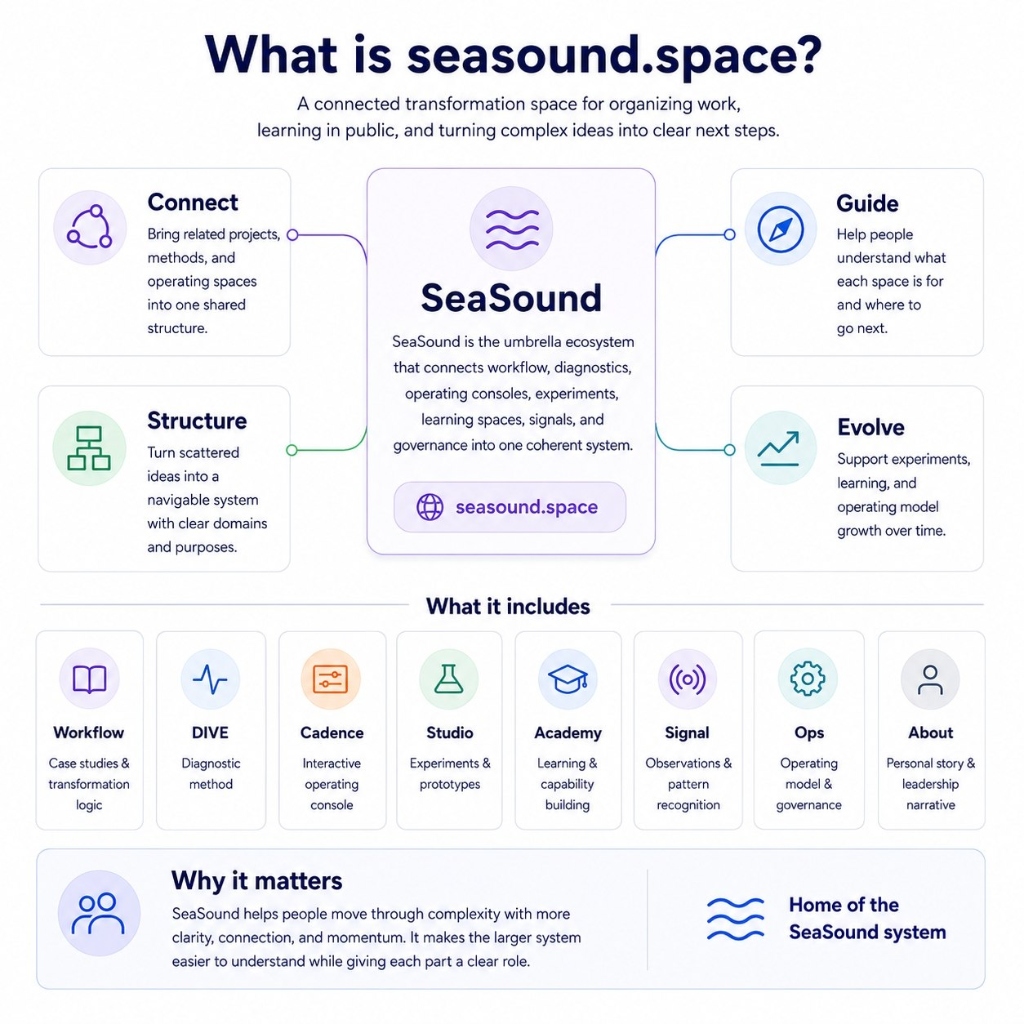
SeaSound
A connected transformation space for organizing work, learning in public, and turning complex ideas into clear next steps.
A connected transformation space for restructuring operating models, optimizing workflow, and turning friction into velocity.
A connected transformation space for engineering orchestration layers, mapping data structures, and deploying deterministic logic.
Welcome to SeaSound. This is a living laboratory where teams learn to untangle operational complexity. I help teams visualize how their work actually moves, where bottlenecks accumulate, and how to redesign systems for speed, clarity, and uncompromising quality.
SeaSound actively redesigns operating models. We locate the exact nodes where manual rework destroys velocity, mapping the "as-is" reality rather than the documented theory. We eliminate handoff waste and sustainably compress cycle times across entire business units.
SeaSound architects the orchestration layer. We design deterministic schemas, human-in-the-loop policies, and the rigid audit trails required to execute secure, high-compliance workflow transformations at scale.
The EcosystemOperating Model ComponentsOrchestration Sub-Systems
Navigate through our core capabilities, diagnostic methods, and learning environments.
Explore the specific methodologies and frameworks used to transform operational flow.
Examine the technical boundaries and data architecture of the ecosystem.
Workflow
Case studies and visual maps of how work actually moves through a system.
Detailed before/after analysis of cycle time compression and handoff elimination.
Technical blueprints showing state-machine logic and integration boundaries.
DIVE Framework
A practical, four-step method (Diagnose, Integrate, Validate, Enable) for solving complex problems.
The core diagnostic methodology for identifying friction and mapping new operational realities.
The governance framework ensuring human-in-the-loop compliance during scale execution.
Cadence
The interactive operating console where theories are tested and work is managed.
The primary interface for executing standardized operating procedures and SLA-tracked gates.
The flagship React front-end application connecting to underlying orchestration APIs.
Operations
The underlying rules, definitions, and governance that keep the system running smoothly.
The centralized repository for RACI charts, capability matrices, and standard operating procedures.
The core data dictionaries, permission scopes, and role-based access control policies.